Get Math Worksheets
Multiplication Practice
Name: ________Date: ________
- 1.5 × 11 =
- 2.5 × 2 =
- 3.5 × 8 =
- 4.5 × 4 =
- 5.5 × 10 =
- 6.5 × 7 =
- 7.5 × 5 =
- 8.5 × 1 =
- 9.5 × 6 =
- 10.5 × 3 =
- 11.5 × 12 =
- 12.5 × 9 =
A free, printable 5 times table worksheet with answers. Print it now or change the questions below.
Grade 3 fact practice and later review
Common Core 3.OA.C.7 sets an end-of-Grade-3 goal to multiply and divide fluently within 100 and recall products of two one-digit numbers. Questions with 10, 11, or 12 as a factor go beyond the one-digit recall requirement.
Get Math Worksheets
Name: ________Date: ________
12 questions · Letter · 1 student page + answer key
Print / Save PDF opens your browser print dialog. Choose Save as PDF there if you want a file.
Get Math Worksheets
Name: ________Date: ________
Get Math Worksheets
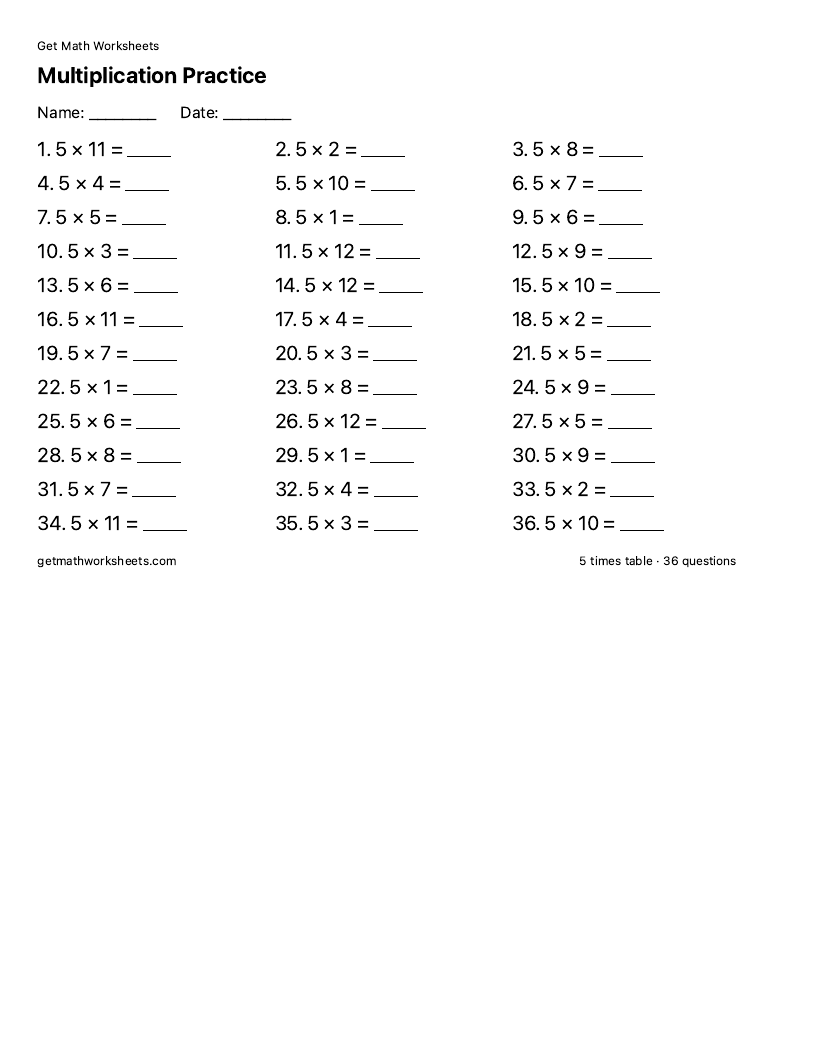
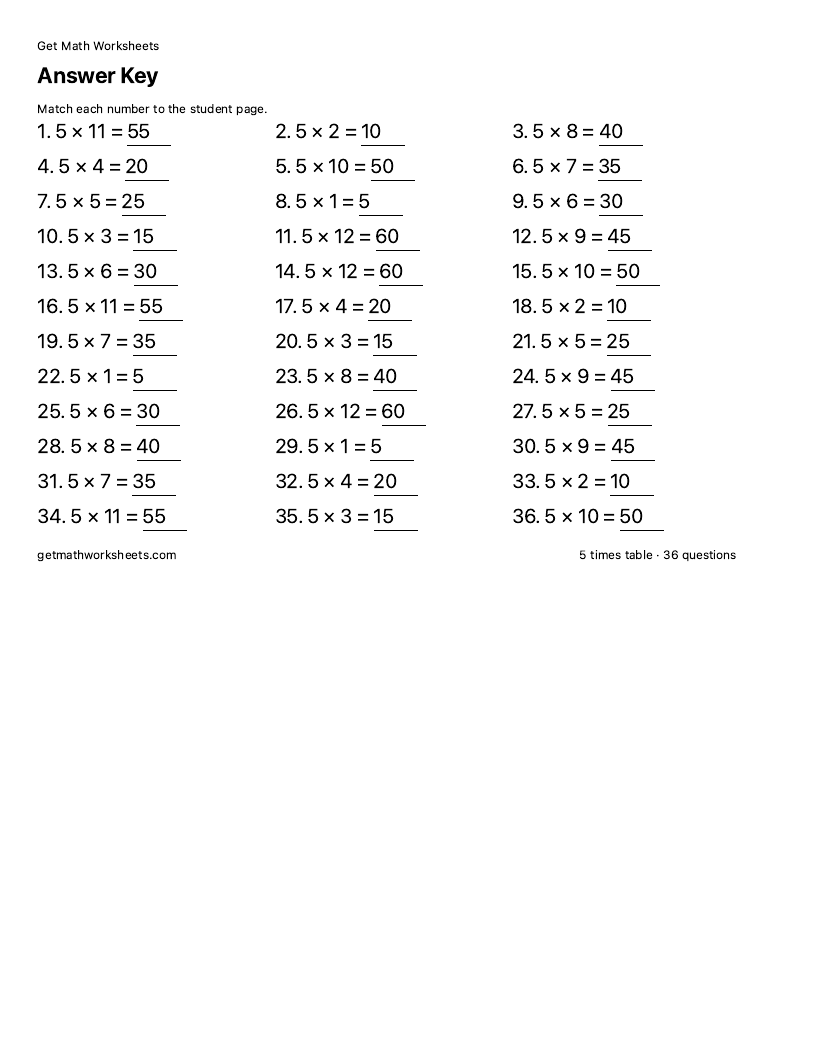
These images are captured from the actual US Letter print output of a 36-question 5 times table sheet. Choose 36 questions above to print this layout; each sheet you make has its own shuffled order and a matching answer key.
Practice with immediate feedback, or take a short scored quiz. No account needed.
Work through facts from the 5s. Practice checks each answer right away; Quiz scores at the end.
Ready for an optional timed round? Open the times tables speed test, choose Clear all, then select the 5s. That page starts with all tables selected; choose the 5s after opening it to focus on this table.
KEEP THIS NEARBY
Use this complete chart to check each fact from 5 × 1 through 5 × 12.
| Fact | Answer |
|---|---|
| 5 × 1 | 5 |
| 5 × 2 | 10 |
| 5 × 3 | 15 |
| 5 × 4 | 20 |
| 5 × 5 | 25 |
| 5 × 6 | 30 |
| 5 × 7 | 35 |
| 5 × 8 | 40 |
| 5 × 9 | 45 |
| 5 × 10 | 50 |
| 5 × 11 | 55 |
| 5 × 12 | 60 |
If the tables before 5 are already known, 5 × 1 through 5 × 4 were practiced in the other order. The 8 new facts run from 5 × 5 through 5 × 12: 5 × 5 = 25, 5 × 6 = 30, 5 × 7 = 35, 5 × 8 = 40, 5 × 9 = 45, 5 × 10 = 50, 5 × 11 = 55, and 5 × 12 = 60.
The ones digits of the answers run 5, 0, and then that sequence repeats. An odd other factor makes the product end in 5, and an even other factor makes it end in 0, as in 5 × 7 = 35 and 5 × 8 = 40. Half of the matching 10s fact is the same product: 10 × 8 = 80 and 80 ÷ 2 = 40.
A dividend that ends in 5 has an odd quotient, and a dividend that ends in 0 has an even quotient. 35 ÷ 5 = 7 pairs an ending of 5 with an odd quotient, and 40 ÷ 5 = 8 pairs an ending of 0 with an even quotient.
The same facts are grouped by divisor on the division chart.
The 5 times table has an easy ending pattern: answers finish in 5, then 0, then 5 again. Counting by fives on a clock or on fingers can help a learner hear the rhythm. Another route is to multiply by 10 and take half: 5 × 8 is half of 80, so it is 40. This works especially well when the 10s are already familiar. Ask the learner to predict whether an answer ends in 5 or 0 before solving it; odd multipliers give 5 and even multipliers give 0. Then use the worksheet to practice recalling the full answer, not only its last digit.